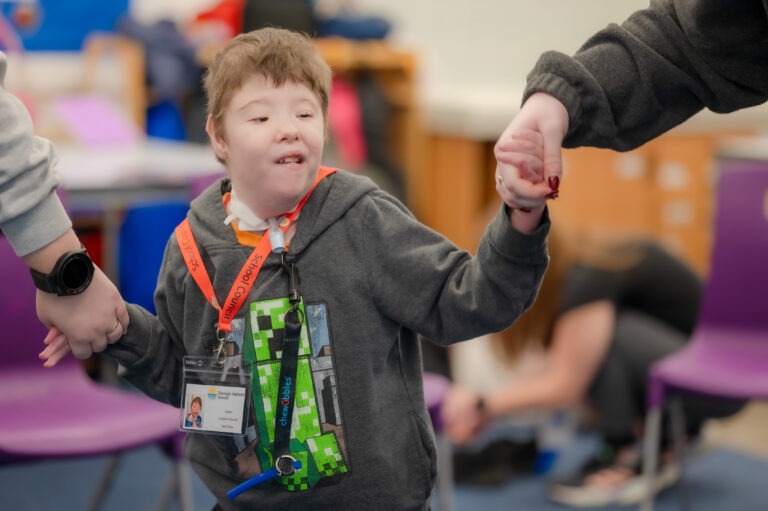
Semi-Formal Explore Pathway
For all our Semi-Formal pupils, we provide a curriculum that reflects the needs of the whole child.
Our Semi-Formal Curriculum approach has allowed us to promote what our pupils need, rather than being constrained by subject areas.
Learners following the Semi-Formal pathway learn through exploring the world around them and access exploratory sessions that enable them to develop independence towards their skills-based objectives.
The areas of learning are designed to teach the pupils in this phase the essential knowledge they need in order to develop the skills and concepts required to achieve the independence we aspire towards.
Developing the use of functional expressive communication is central to learning. Pupils are encouraged to engage and form secure relationships with adults to support their engagement in adult-led activities.
Independence is always encouraged through a tiered system of adult modelling, sabotage and reducing adult support.
Behaviour for learning is also essential to the Semi-Formal curriculum. Staff use consistent strategies for each individual pupil to support them to be in a sensory and emotionally regulated state ready to learn.
Semi-Formal pupils use the curriculum themes as vehicles for skills-based learning. Class staff teams take the pupils motivators into account to promote learner engagement.
Teaching and learning is strengthened through the pupils’ motivation towards exploring the activities provided. Adults support the pupils to access activities with functional self-help, play and communication skills.
A mixture of child-led and adult-led learning enables a good working relationship between pupils and staff in the Semi-Formal pathway.
Our schemes of work are developmental and not related to age or Key Stage.
The pupil begins at their point of learning and each learning journey will be personal.
Our pupils have difficulties with generalising skills and concepts and in order for learning to be meaningful and successful, opportunities for holistic development are presented in real life contexts, where pupils can learn by “doing” and practising the skills that they will need to be happy, healthy, safe and successful in their life beyond school.
Our Semi-Formal Primary learning programme includes:
- My Independence
- My Communication
- My Thinking and Problem Solving
- Myself & My Body
- My World & My Community
- My Creativity
- SRE
- RE
Our Semi-Formal Secondary learning programme includes:
- My Independence
- My Communication
- My Thinking and Problem Solving
- Myself & My Body
- My World & My Community
- My Creativity
- SRE
- Careers Education
- RE
The curriculum recognises that some pupils following the Semi-Formal pathway will be beginning to access learning through slightly more formal subjects, although not yet at National Curriculum level.